Sunday, January 9, 2011

The leafiness of trees

Do the trees, in full leaf, find their canopies burdensome? Is it a strain for their branches to hold up such large leafy heads?

The flame tree, that I've watched come into leaf so gradually, is now in full dress. The melia, whose sprouting branches I charted in spring, is bushy and full. So far, so good. But when I took a walk past the park, a woman danced towards me on the street with strange gestures, uttering an odd cry. Did I know her? No, but she'd just got a fright.

As she walked past the park, she heard a crash. Turning her head she saw that a branch had just fallen from a large leafy lime tree. 'Look, there it is', she said. I was amazed to see the size of the branch, the large tear in it, and the tree. We speculated on what had brought the branch down, and could find no answer. It's not as if the day was windy; in fact the air was still and humid. There hadn't even been a recent storm. And the branch looked perfectly healthy.

As I walked away I began to muse on the consequences of being in full leaf: parents with many children who are all reaching maturity; wealth that becomes a burden; bloated economies, global warming . . . Not that the tree fell into these categories. Maybe it was simply too successful in putting out its head of leaves, or maybe the branch stretched out too far from the main trunk - out on a limb, so to speak. My mother's voice in my head had the final word: 'You can have too much of a good thing.'

Friday, January 7, 2011

Leafy streets

Back in the city, I walk the streets. People are still away on holiday, and the streets are quiet. There's something special about a city that has emptied out over summer. It feels gentle, and the beauty of the streets is easier to see without the distraction of cars.

And so I walk pavements now, rather than bush paths, sand, stream bed and beach. I see strange, exotic flowers, like this unknown pink one, hanging over a fence. The trees are in full leaf, offering up welcome shade on a hot day.

And then, an old friend appears: a puriri tree from which dangle these cheeky pink fruit, together with clusters of pink flowers.


I miss the bach, but the city offers its summer gifts and helps me make the necessary transition.

Thursday, January 6, 2011

Farewell

The holiday is over. This glorious time of drifting, playing, pottering, snoozing, swimming, walking, cooking, eating and standing still in wonder, has come to an end.

Last night I caught a special light on the hill: slanting highlights and long shadows, which matched my mood exactly: a mix of sadness and gratitude.

There's something so poignant about that moment, when a house that has been filled with love and laughter, suddenly empties itself out. The walls feel further apart somehow, and the ceiling higher. The silence vibrates with what has been.

This morning, with the family gone and rain gently falling, I tidied up some more and paused to gather the relics of Mira's stream adventures: a feather, a stalk of bunny grass, and an unknown dune grass. Here they are, holding the sweet memories of witnessing a little one bonding with nature, and with this place: a bond that I hope will be strengthened with every passing year.

Wednesday, January 5, 2011

Little suns

Mornings at the bach are special. I'm woken by the serenade of the tuis, whose song is so much more resonant and throaty than the tuis in town. The air is cool and I wander among the garden plants, checking how they are, giving them water, and picking off bugs.


The garden is full of little suns: the courgette flowers which open so sensuously, offering their dusty golden pollen up to the bees, and the marigolds which are dotted around as companion plants. On a cloudy morning, these are the first suns to strike.

And this morning the kereru visited again, with a mate. So there, high in the kanuka, I am blessed by the presence of the priest and priestess of the tree tops.

Tuesday, January 4, 2011

Summer simplicity

Life is deliciously simple at the bach. Even though some tasks  take longer, time stretches a long hand as we relax into another week of holiday.
For water, we depend on rain to fill the tank. The toilet is a long-drop in the trees. Music comes from records played on a turntable. A shower is a gentle experience, with a gravity-fed showerhead down on the lower level. The garden must be hand-watered with buckets since there is no water pressure for a hose.

To sweep the gravel paths, I find that the best possible broom is a head of manuka twigs. This of course is how brooms were invented, and I think of my ancestors thousands of years ago picking up just such a bushy branch. This little broom lifts the leaves off the path and steps without taking the gravel with it: perfect.


Little Mira makes her own toys, playing with leaves, or riding in a cardboard box which is a boat one day, a train the next, and today, a fire truck. She has now made her own helicopter by pushing a match stick through a hole in a pohutukawa leaf.
As soon as the sun goes down we close the windows and doors that don't have screens, in order to protect against the mosquitoes.
Such simplicity. And so the days pass by in that lazy rhythm which is summer's own.

Monday, January 3, 2011

Back in the surf

The end of the day is the best time to swim when summer has arrived in full force, with a blazing sun. I got back on my board after twisting my ankle when I was thrown off some days ago, and rode the waves once more.

What a good feeling to be fizzing in the surf again, feeling the undertow and waiting for it to ease, then picking the right wave to ride.

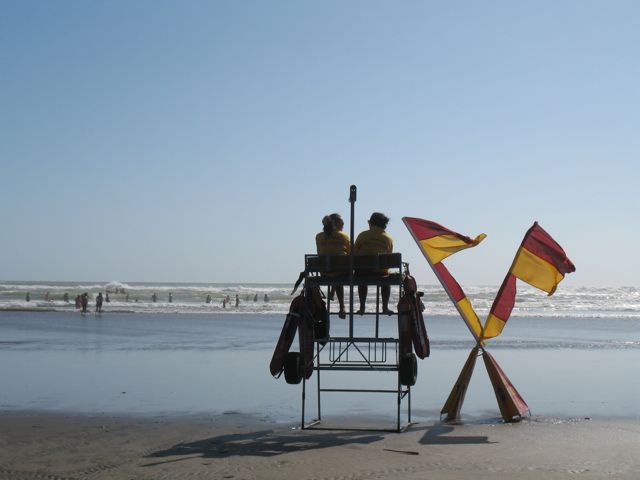
Then the sun went down a little more, the life guards crossed the flags, signalling that they were soon to finish for the day. Sandcastles were washed away by the incoming tide, leaving only memory marks, and we returned hungry and tired to the bach. Some days are perfect, and this was one of them.

Morning visitor


On my way to the 'long drop' in the morning I heard a distinctive sound in the tree tops: a 'whoosh-whoosh' of wings. Aha, a wood pigeon! I thought, and sure enough, there it was perched in the top branches of the kawakawa, pulling off one candle-shaped fruit after another.

It was so absorbed in this morning feast that I was able to approach quite close and photograph its graceful movements. The kereru, as the Maori call it, is a rare visitor, and I'm always in awe of this beautiful bird. It's breast is white and fat, yet the head and neck are slender and elegant. It's so big I'm always surprised to see it flying.

At the end of its feeding session it winged its way up into the sky, then swooped down into some far away trees. I was left feeling stilled by my encounter with this priest of the tree tops.